
The Paper Guide Package Labeling

| Basis Weight and Finish |
|---|
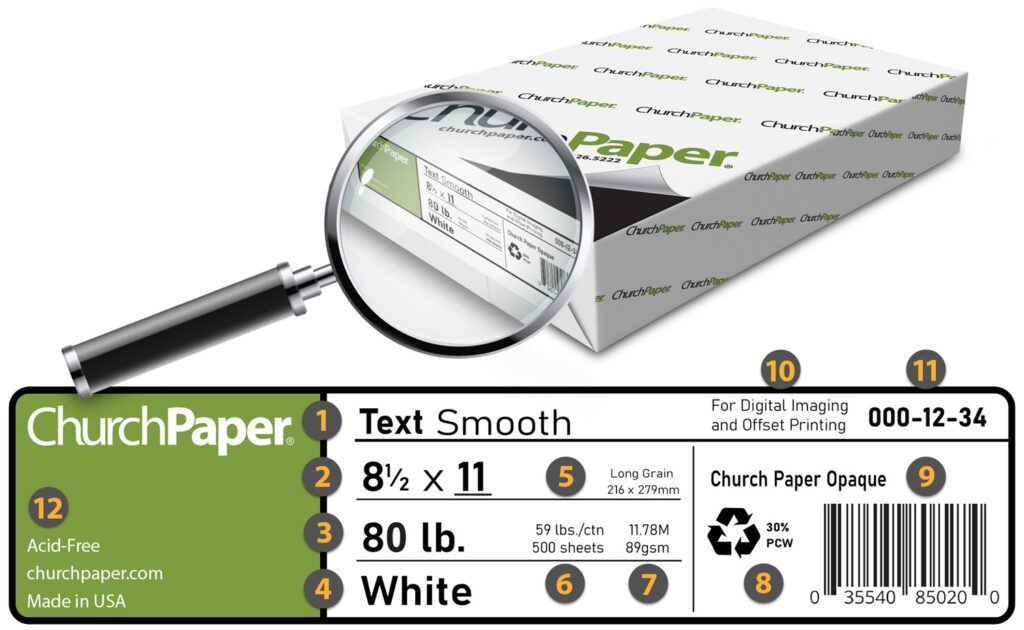
| The label may identify both the paper basis weight, such as Bond, Text or Cover, and its surface finish, such Smooth, Vellum or Linen.
These terms can tell you both the paper category and what the surface may look and feel like. |

| Paper Size |
|---|
| The dimensions of the sheet are typically listed in inches, such as 8½" × 11", 8½" × 14" or 11" × 17".
The order in which those dimensions appear may also provide information about the paper's grain direction. |

| Paper Weight |
|---|
| Paper weight is commonly shown as a basis weight, such as 20 lb., 60 lb. or 80 lb.
Because different paper categories use different basis sizes, the pound number alone doesn't always tell you which paper is heavier or thicker. |

| Paper Color |
|---|
| The manufacturer's name for the paper color is usually printed on the label.
Color names aren't standardized across every paper manufacturer, so shades with similar names can vary from one paper line to another. |

| Grain Direction |
|---|
| Some manufacturers indicate the direction in which the majority of the paper fibers are aligned.
Typically, the last dimension listed indicates the grain direction. That dimension may also be underlined to make the grain direction easier to identify. |

| Package and Carton |
|---|
| The label may indicate the total number of sheets included in the package and the approximate weight of a carton.
This can be helpful when comparing package quantities, planning storage or estimating the weight of larger paper orders. |

| M Weight and GSM |
|---|
| M Weight is the actual weight, in pounds, of 1,000 sheets of a particular paper at its specified finished size. GSM (grams per square meter) describes how many grams one square meter of the paper weighs.
Unlike Basis Weight, M Weight and GSM take the actual sheet dimensions into account. This makes them useful for paper and printing industries to calculate quantities and shipping weights. |

| Recycled Content |
|---|
| Labels may indicate the percentage of the paper manufactured from recycled fiber.
You may also see PCW, which stands for Post-Consumer Waste. This refers to material that has already been used by consumers and recovered for recycling rather than being discarded. |

| Item Description |
|---|
| The Item Description identifies the specific paper product or product line inside the package.
It typically includes the manufacturer or brand name and may include additional identifying details that distinguish the paper from other products. |

| Recommended Uses |
|---|
| Some paper packaging identifies recommended applications or printing processes, such as digital printing, laser printing, inkjet printing or offset printing.
These recommendations can help you determine whether the paper is suitable for your equipment or intended application. |

| SKU Number |
|---|
| A manufacturer's item number, SKU or product code identifies a specific paper configuration.
Because two papers can share the same brand name while differing in size, weight, color or finish, the item number can be especially useful when reordering an exact product. |

| Acid-Free |
|---|
| An acid-free designation indicates that the paper is manufactured to resist the deterioration and yellowing that can occur as some papers age.
This can make acid-free paper particularly useful for documents, records, books, certificates, artwork and other materials intended to be kept for an extended period. |