
The Paper Guide Paper Thickness
Home > The Paper Guide >
Paper Thickness
Understanding Paper Thickness, Caliper & Points
When choosing paper, weight is only part of the story. Understanding thickness can help you choose a paper that has the right feel, durability and performance for your project.
The Basics: Understanding Paper Thickness ↴
How is Paper Thickness Measured?
Paper thickness is the actual thickness of a single sheet of paper. A precision measuring tool called a micrometer, sometimes referred to as a caliper, is used to determine the thickness of the sheet. The paper is placed between the tool’s measuring surfaces to provide an accurate measurement. In the paper industry, the term caliper is commonly used to describe this measurement of paper thickness.
Unlike paper weight, which can be expressed using different measurement scales depending on the type of paper, paper thickness is straightforward:
The higher the caliper, the thicker the sheet.
Paper thickness is commonly expressed in Points (pt.) or thousandths of an inch (0.001").
1 point = .001 inch
Paper Thickness Quick Guide
Use this chart as a general guide for understanding how caliper measurements compare.
| Caliper | Thickness in Inches | General Description | ||||
|---|---|---|---|---|---|---|
| 4 pt. | .004" | Thin | ||||
| 6 pt. | .006" | Medium-Light | ||||
| 8 pt. | .008" | Medium | ||||
| 10 pt. | .010" | Substantial | ||||
| 12 pt. | .012" | Thick | ||||
| 14 pt. | .014" | Very Thick |
Important: These descriptions are intended only to help visualize increasing thickness. Caliper does not determine paper weight, stiffness or suitability for a particular printer.
Deep Dive: Paper Weight vs. Paper Thickness ↴
Paper Thickness Is Not the Same as Paper Weight
One of the most important things to understand about paper is that paper weight and paper thickness are not the same measurement. Paper weight tells you how much a specified quantity and size of paper weighs. Paper thickness tells you the actual thickness of an individual sheet. Although heavier papers are often thicker, you cannot reliably determine a paper’s thickness from its weight alone.
Two papers can both be labeled 80 lb. Cover and still have noticeably different thicknesses.
For Example:
| Paper | Weight | Approx. Thickness | ||||
|---|---|---|---|---|---|---|
| Sylvamo Accent Opaque Cover | 80 lb. Cover | 11 pt. = .011" | ||||
| Hammermill White Color Copy Cover | 80 lb. Cover | 8.9 pt. = .0089" |
Both papers are 80 lb. Cover, but the 11 pt. sheet is approximately 24% thicker than the 8.9 pt. sheet. That's why two papers with the same weight can feel quite different in your hand.
Always check the paper's caliper rather than relying on the paper weight alone.
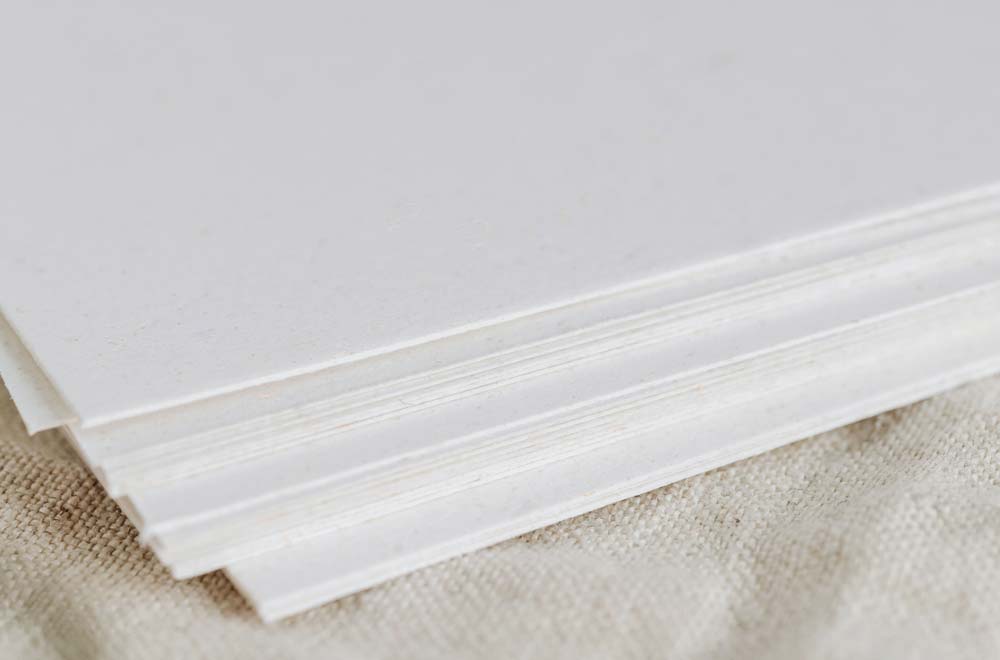
Same Weight, Different Thickness
Paper isn’t simply manufactured to a particular weight and thickness. Its characteristics depend on how the sheet is made. Several factors can affect the relationship between weight and thickness, including:
Paper Density
A more densely manufactured sheet can contain similar paper weight in a thinner sheet.
Finish and Manufacturing
Processes used to create smooth, vellum, textured, coated and other finishes can affect the paper’s final thickness.
Fiber and Composition
The fibers and other materials used to manufacture a sheet can influence both its density and thickness.
Compression
Paper can be compressed during manufacturing to create a smoother, denser sheet. This can reduce thickness without necessarily producing an equivalent reduction in paper weight.
The result is that two papers with the same basis weight can have different calipers—and two papers with similar calipers can have different basis weights.
Why Does Paper Thickness Matter?
Thickness affects more than how substantial a sheet feels. Depending on your project, caliper can influence:
Feel and Presentation
A thicker sheet generally feels more substantial in the hand, which may be desirable for covers, cards, invitations, announcements and other pieces where presentation matters.
Folding
As paper becomes thicker and more substantial, folding characteristics change. Heavy or thick stocks may benefit from scoring before folding to help produce a cleaner fold and reduce cracking.
Printer Compatibility
Printers and copiers have limits on the paper they can reliably feed through the machine. A printer that accepts a particular paper weight does not necessarily accept every paper of that weight because thickness can vary between papers with the same weight designation. Always check your printer manufacturer’s specifications when using heavier or thicker paper.
Mailing and Finished Pieces
Thickness can also matter when a printed piece will be folded, inserted into an envelope, bound or mailed. The thickness of multiple sheets can add up quickly.