
The Paper Guide Paper Weights
Home > The Paper Guide >
Paper Weights
Understanding Basis Weight & GSM
Paper weight can be one of the most confusing parts of choosing paper. A sheet described as 80 lb. may actually be heavier than one labeled 110 lb., and two papers with different pound ratings can sometimes be the same weight. The reason: Paper measured in pounds (lbs.) does not use one universal scale.
Understanding Basis Weight and GSM makes it much easier to compare papers and choose the right one for printing.
The Basics: Paper Weights at a Glance ↴
Basis Weight & GSM Explained
Basis Weight
Paper in the United States is traditionally measured using Basis Weights. Each Basis Weight category has its own scale, so pound (lb.) ratings should only be compared when you know which type of paper they describe. Think of it like Celsius and Fahrenheit. Both measure the same thing—temperature—but use different scales and numbers to describe it. Paper Basis Weights work in a similar way.
GSM
GSM is a standardized metric measurement expressed in grams per square meter (g/m²). It is widely used in Europe, Asia and international printing industries to indicate how heavy and dense a sheet of paper is. GSM provides the easiest way to compare the actual weight of papers across categories. You may also see GSM listed in your printer’s paper or media type settings, where it can help you select the appropriate setting for the weight of paper you are using.
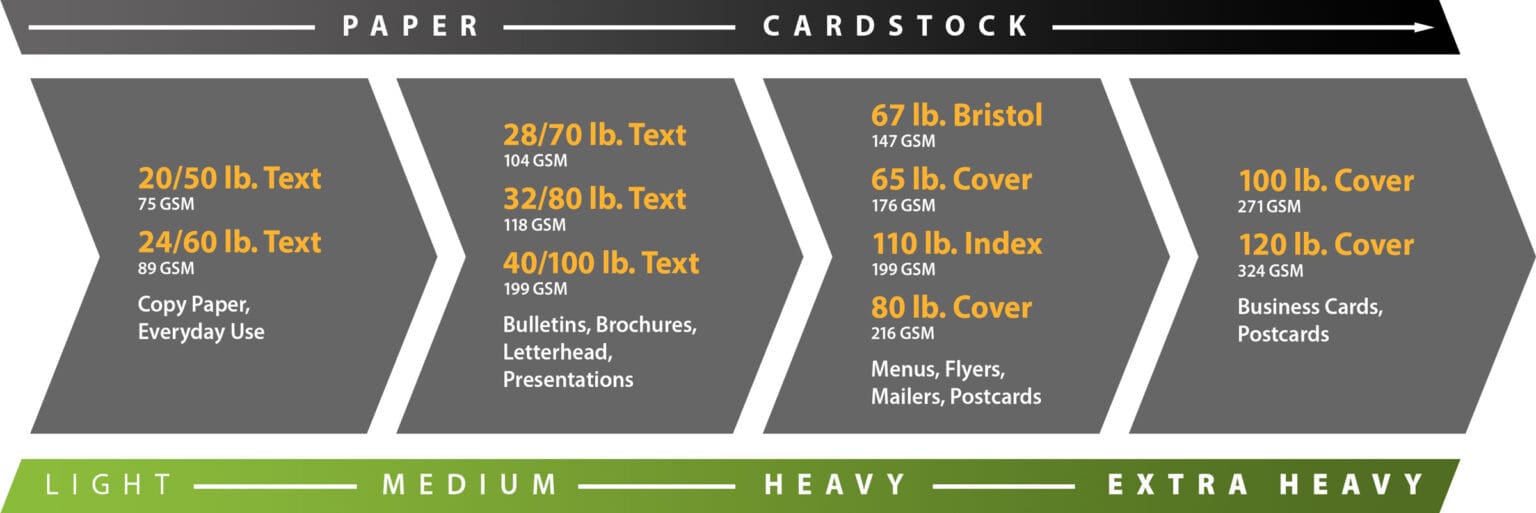
Paper Weight Quick Guide
Deep Dive: How Paper Weights Really Work ↴
What Is Basis Weight?
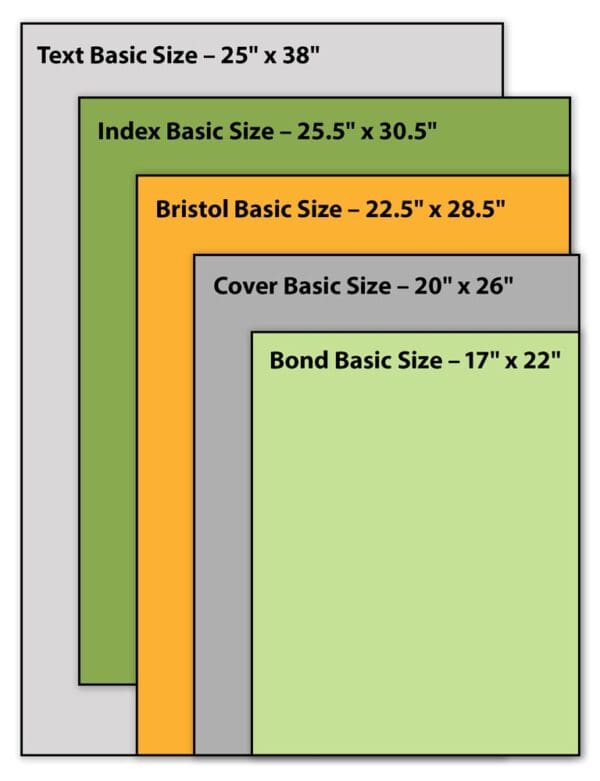
Basis weight is the traditional way of describing paper weight in the United States. It is based on the weight of a ream (500 sheets) of that paper category's standard sheet size, referred to as it's basic size. These large basic size sheets come from commercial papermaking with each paper category having its own traditional size.
Basic Sheet Sizes
| Category | Sheet Size | |||
|---|---|---|---|---|
| Bond | 17 in x 22 in | |||
| Text | 25 in x 38 in | |||
| Cover | 20 in x 26 in | |||
| Index | 25.5 in x 30.5 in | |||
| Bristol | 22.5 in x 28.5 in |
80 lb. Text means that, by definition, 500 sheets of that Text paper at its basic size of 25" × 38" weighs 80 pounds.
The paper can then be cut down into more familiar finished sizes—such as 8.5" × 11" or 11" × 17"—and it is still called 80 lb. Text.
Common Basis Weights and Uses
| Paper Weight | Basis Weight | Common Uses | ||||
|---|---|---|---|---|---|---|
| Light | 20 lb. Bond, 50 lb. Text 24 lb. Bond, 60 lb. Text |
Copy Paper, Everyday Use | ||||
| Medium | 28 lb. Bond, 70 lb. Text 32 lb. Bond, 80 lb. Text 40 lb. Bond, 100 lb. Text |
Bulletins, Brochures, Letterhead, Presentations | ||||
| Heavy | 67 lb. Bristol 65 lb. Cover 110 lb. Index 80 lb. Cover |
Menus, Flyers, Mailers, Postcards | ||||
| Extra Heavy | 100 lb. Cover 120 lb. Cover |
Business Cards, Postcards |
Paper Basis Weights
For lightweight paper, there are two Basis Weights:
Bond and Text
Bond and Text are different Basis Weight scales, but equivalent papers are often labeled with both measurements.
For example, a paper may be labeled:
24/60 lb.
This means the paper is approximately:
24 lb. Bond = 60 lb. Text
It is not a 24 lb. paper combined with a 60 lb. paper, the two numbers are simply different ways of expressing approximately the same paper weight using two different Basis Weight systems.
Common Bond and Text Weight Equivalents
| Bond Weight | Text Weight | Labeled As | ||||
|---|---|---|---|---|---|---|
| 20 lb. Bond | 50 lb. Text | 20/50 lb. | ||||
| 24 lb. Bond | 60 lb. Text | 24/60 lb. | ||||
| 28 lb. Bond | 70 lb. Text | 28/70 lb. | ||||
| 32 lb. Bond | 80 lb. Text | 32/80 lb. |
Cardstock Basis Weights
Heavyweight paper is referred to as Cardstock. It may be classified using the following Basis Weights:
Cover, Index and Bristol
Once you move into heavier paper and cardstock, pound (lb.) ratings can become even more confusing.
For example:
80 lb. Cover is heavier than 110 lb. Index.
At first glance, 110 lb. sounds heavier than 80 lb., but the two numbers come from different Basis Weight systems with different Basic Sheet sizes. Simply asking whether 80 lb. or 110 lb. paper is heavier doesn’t provide enough information. You must know what basis weight the paper is classified as.
Cardstock Weights in Order of Heaviness
| Basis Weight | GSM | |||
|---|---|---|---|---|
| 67 lb. Bristol | 147 GSM | |||
| 65 lb. Cover | 176 GSM | |||
| 110 lb. Index | 199 GSM | |||
| 80 lb. Cover | 216 GSM | |||
| 100 lb. Cover | 271 GSM | |||
| 120 lb. Cover | 324 GSM |
What Is GSM Paper Weight?
GSM stands for grams per square meter (g/m²). Instead of weighing a fixed number of sheets at different basic sizes, GSM describes how many grams one square meter of the paper weighs. That makes GSM a much more consistent way to compare different types of paper.
With GSM:
The higher the GSM, the heavier the paper.
A 200 GSM sheet has more mass per unit area than a 100 GSM sheet, regardless of whether the manufacturer calls the paper Bond, Text, Cover or something else. This makes GSM especially useful when comparing papers across different Basis Weight categories.